
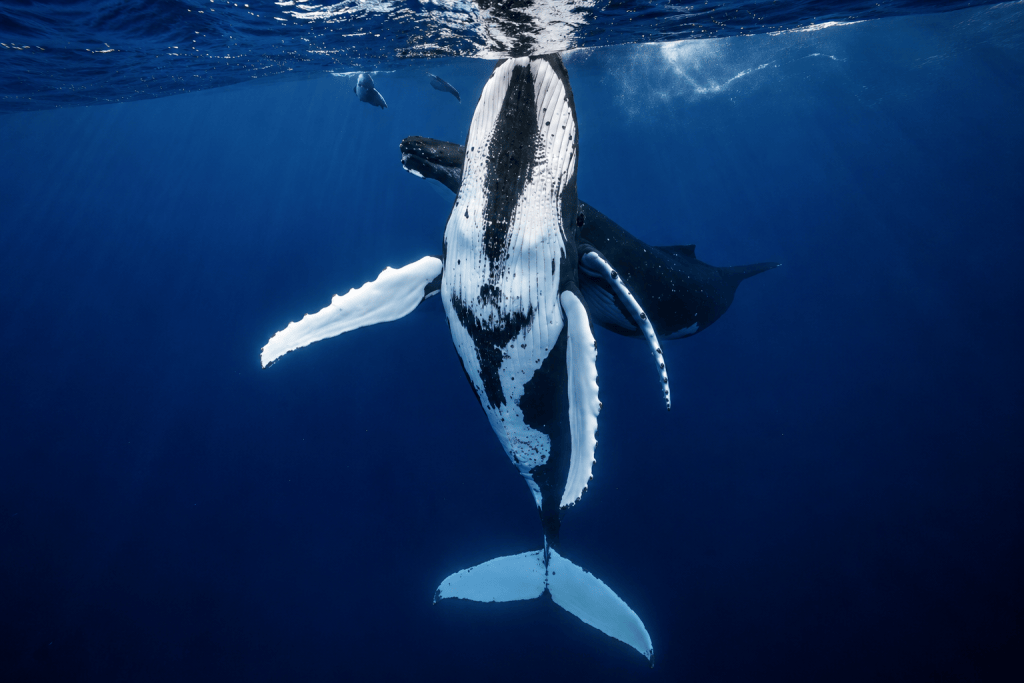
Mo’orea offers the extraordinary opportunity to observe humpback whales in their natural environment, from mothers swimming alongside their newborn calves to males singing beneath the surface. Surrounded by dramatic volcanic mountains and the deep blue waters of the South Pacific, every encounter offers a unique glimpse into the lives of these magnificent marine mammals.
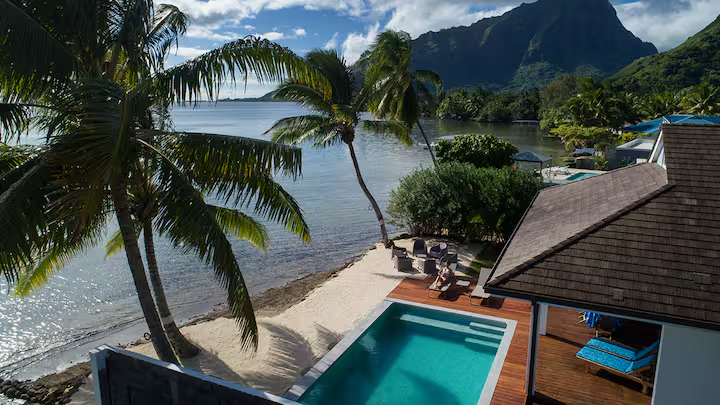
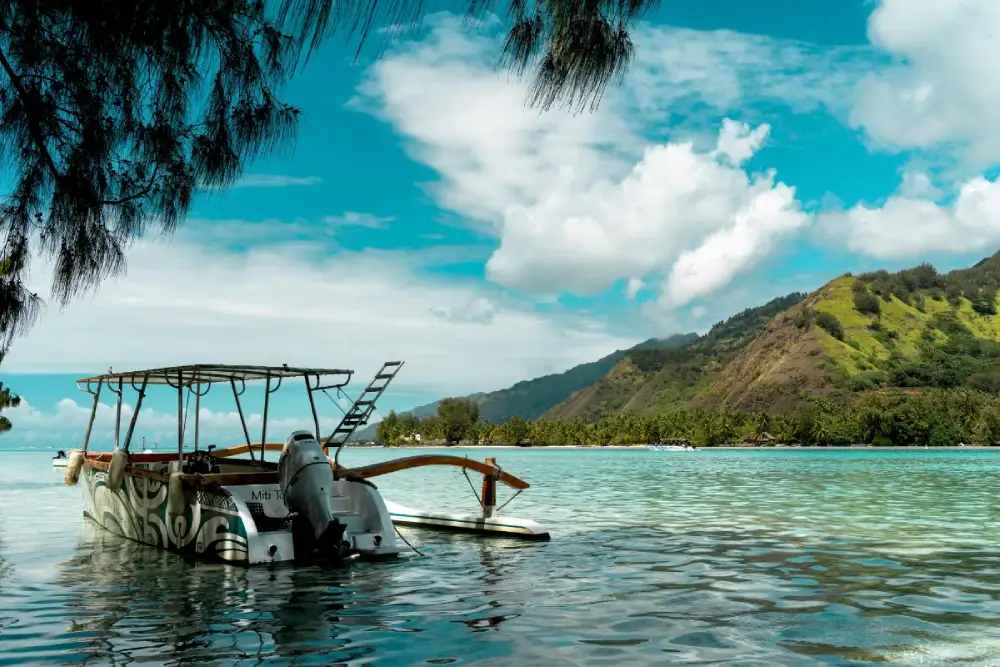
Located just northwest of Tahiti, Mo’orea is one of French Polynesia’s most remarkable islands, known for its volcanic mountains, turquoise lagoons, and extensive coral reef system.
Beyond the barrier reef, the seabed drops into the deep waters of the South Pacific, creating an environment where large marine species can be encountered relatively close to shore.
Its combination of accessible ocean waters, tropical climate, and rich marine biodiversity makes Mo’orea an exceptional destination for ocean exploration.
Read our complete guide to FRENCH POLYNESIA
Mo’orea vs Tonga: Where Should You Swim with Humpback Whales?



15 – 20 AUGUST 2027
APPLY NOWPRICE : 3.400€
FAQs
Is August a good time to swim with humpback whales in Mo’orea?
Yes. August is one of the best months to swim with humpback whales in Mo’orea, French Polynesia. Every year, humpback whales migrate from their Antarctic feeding grounds to the warmer waters of French Polynesia to breed, give birth and nurse their calves.
August falls within the established whale season, offering opportunities to observe adult humpbacks, mothers with calves and a variety of natural behaviours. However, encounters depend entirely on the animals and ocean conditions.
When is the Mind the Seas Mo’orea whale swimming expedition in 2027?
Our Mo’orea Humpback Whale Expedition takes place August 15–20, 2027, during the seasonal migration.
The expedition includes four full days and one half day on the ocean, allowing us to explore different areas around the island and adapt to changing conditions.
How many days will we spend swimming with whales?
Our expedition includes four full ocean days and one half day, with opportunities for regulated in-water humpback whale encounters whenever conditions and whale behaviour allow.
We dedicate multiple days to the experience because wildlife cannot be scheduled. Some days bring extraordinary observations, while others require patience and exploration.
Are humpback whale encounters guaranteed?
No. We never guarantee encounters with wild animals.
Although August is an excellent time to visit Mo’orea, whale sightings and swimming opportunities depend on their presence, behaviour, weather and ocean conditions.
Our philosophy at Mind the Seas is simple: we follow nature’s rhythm, not the other way around.
Do I need to be a certified scuba diver?
No scuba diving certification is required. Swimming with humpback whales in Mo’orea is a snorkelling activity conducted at the ocean’s surface.
However, you must be comfortable swimming in open water and capable of following your guide’s instructions in changing ocean conditions.
Previous snorkelling experience is strongly recommended.
Do I need freediving experience to swim with whales?
No. Freediving experience is not necessary.
All whale encounters are conducted at the surface using a mask, snorkel and fins. Participants should not dive down towards whales or attempt to approach them underwater.
Being a confident, relaxed swimmer is far more important than being able to hold your breath.
How many people will be swimming with the whales?
Our expedition is designed around small in-water groups, with a maximum of six guests accompanied by a qualified guide under the 2026 regulations.
Our aim is to create intimate, responsible encounters without overcrowding the water or placing unnecessary pressure on the animals.
The final group arrangements will comply with the regulations applicable in August 2027.
How close can we get to humpback whales?
Under French Polynesia’s 2026 regulations, swimmers must maintain a minimum distance of 15 metres from humpback whales.
We never chase, touch, surround or deliberately approach whales more closely than permitted.
Sometimes whales may move through the same area as swimmers, but all interactions must remain respectful of their natural behaviour.
At Mind the Seas, the animal’s welfare always comes first.
Can we swim with mother and calf humpback whales?
Mother-calf pairs are among the humpback whales that can be observed around Mo’orea during the breeding season.
However, these animals require particular care. Mothers are nursing their calves, and disturbance may affect essential resting and maternal behaviour.
Not every mother-calf sighting is appropriate for an in-water encounter. Our local guides will assess each situation and follow the applicable regulations.
What is the water temperature in Mo’orea in August?
During the austral winter, sea temperatures around Mo’orea generally remain tropical, with regional winter conditions described at approximately 21–27°C.
Actual temperatures vary, and spending extended periods in the water can feel cooler than expected.
A wetsuit is recommended for thermal comfort during whale-swimming excursions.
What happens if the weather is bad?
Mo’orea’s geography offers different coastal exposures, so our local captain may sometimes find more suitable conditions on another side of the island.
However, rough seas, strong winds or poor visibility can make whale swimming unsafe.
When necessary, we may adapt the day’s activities or cancel an ocean excursion. Safety and wildlife welfare always take priority.
Any changes, rescheduling or refunds are governed by the applicable booking conditions.
Is swimming with humpback whales ethical?
Swimming with humpback whales can be conducted responsibly when strict conservation rules are followed and the animals remain free to behave naturally.
French Polynesia is a designated marine mammal sanctuary, and whale observation is regulated.
At Mind the Seas, we work with local professionals and follow an animal-first approach. We never encourage chasing wildlife, forcing interactions or disturbing mothers and calves.
We believe that the privilege of observing these animals comes with a responsibility to protect them.
What equipment do I need to bring?
Bring comfortable swimwear, sun protection, a towel and any personal equipment you prefer to use.
Our local ocean operator provides snorkelling equipment and offers wetsuits or flotation equipment, along with refreshments during excursions.
If you have your own mask and snorkel, bringing them can make your experience more comfortable.
We will share a detailed packing list before departure.
Can I take underwater photos and videos?
Yes, personal underwater photography is possible when it respects the applicable regulations and the guide’s instructions.
Mo’orea can offer extraordinary opportunities to photograph humpback whales in open water.
However, we never approach animals more closely to obtain a photograph, and photography must never interfere with their behaviour.
Commercial filming may require additional permits from the French Polynesian authorities.
How do I get to Mo’orea, French Polynesia?
The usual route is to fly into Faa’a International Airport in Tahiti (PPT).
From Tahiti, Mo’orea is accessible by ferry, with crossings generally taking approximately 30–45 minutes, depending on the service.
We recommend planning your international arrival with sufficient time for the transfer to Mo’orea.
Detailed arrival information will be provided to confirmed expedition participants.
What can we do in Mo’orea besides swimming with whales?
Mo’orea is much more than a whale-swimming destination.
The island offers spectacular volcanic landscapes, coral reefs, tropical valleys and a rich Polynesian cultural heritage.
During free time, travellers can explore Opunohu Valley, discover local food and traditions, snorkel around coral reefs or observe marine life such as reef sharks, stingrays and sea turtles.
For us, an expedition is about experiencing the destination as a whole, not simply encountering one species.
What makes the Mind the Seas whale expedition different?
At Mind the Seas, we create small-group expeditions around extraordinary natural events, with a strong focus on responsible wildlife encounters and meaningful ocean exploration.
Our Mo’orea expedition is not designed around a checklist of guaranteed sightings.
It’s about spending time at sea, learning to understand humpback whales, exploring an exceptional marine environment and sharing the experience with people who have a genuine passion for the ocean.
We believe the best wildlife encounters are never forced.
They are earned through patience, curiosity and respect.
How can I join the Mind the Seas Mo’orea expedition in August 2027?
Our Mo’orea Humpback Whale Expedition runs from August 15–20, 2027, with a limited number of guest swimming places.
To learn more about availability, pricing, accommodation arrangements and the detailed itinerary, contact our team or visit our French Polynesia expedition page.
Join us to experience one of the ocean’s great migrations, in one of the most remarkable island environments on Earth.
Diving to the Origin.